

How it works

Field service dispatch & route optimization

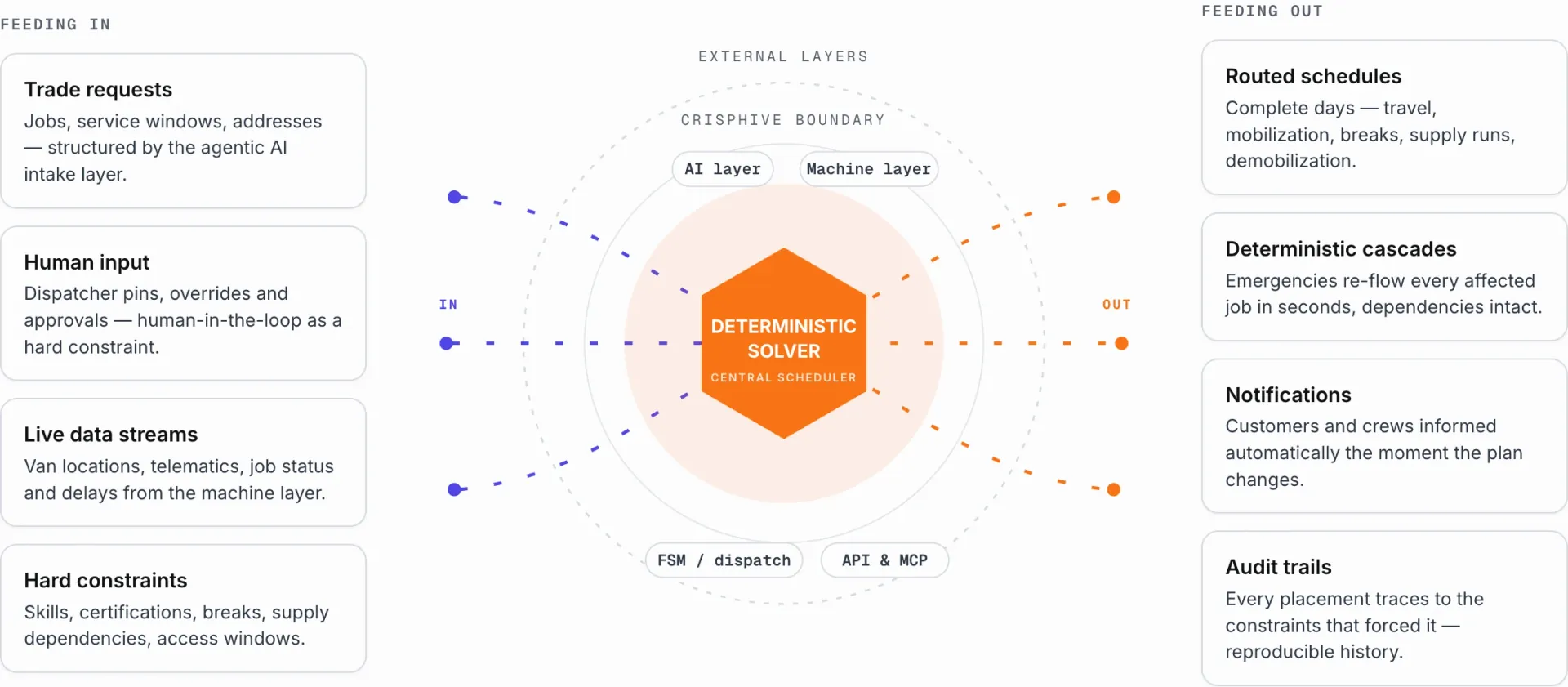
The Crisphive solution: one scheduling brain for the whole day. It matches every request to the right crew, routes the day around real-world constraints, and re-plans everything the moment an emergency lands.

  • Match the request to skills, location & availability
  • Route the day — travel, mob, demob, breaks, supply runs
  • Cascade the schedule when emergencies hit

Step 1 / Match

Every request meets the one crew that can actually do it

Crisphive intersects what the customer needs — the job, their windows, their address — with what your business has on the ground: who's qualified, who's free, and who's already nearby.

The request — customer side

Job typeAC installation
Skills requiredAC InstallationAC Repair
Estimated on-site120 min
Mobilization / demob15 + 15 min
Service address100 King St W, Toronto
Customer windowsTue eve · Wed AM · Thu AM

Your operation — business side

Priya Patel

LeadHVAC Technician

FREE WED AM

Emma Smith

BuddyHVAC Technician

FREE WED AM

James Carter

LeadRefrigeration

BOOKED ALL WEEK
Van 3 — last job Tuesday2.1 km away
Crisphive finds the intersection

Offered to the customer — instantly

JUL
14
Evening (4PM – 8PM)
JUL
15
Morning (8AM – 1PM)
JUL
16
Morning (8AM – 1PM)

Only windows where skills, people, vans and travel time all line up are ever offered — so a confirmed booking is a booking your business can actually keep.

Steps 2 & 3 / Route, then cascade

The whole day, planned like a supply chain

Each booking carries its real anatomy — mobilization, job duration, demobilization — and the day is routed with travel time, breaks, supply runs and job dependencies built in. Then try the button.

The dependencies — everything a job drags with it

Travel time — the drive between stops. Reorder the day and every leg changes length.

Mobilization — park, unload, stage, set up. The clock runs before the first bolt turns.

Job duration — the actual wrench time on site. The only part most calendars plan.

Demobilization — pack-up, clean-up, paperwork. The job isn't done when the work is.

Breaks — protected crew rest. Crisphive moves them, but never silently deletes them.

Supply runs — parts pickups locked before the jobs that need them, wherever the day lands.

None of this is padding — it's a chain. Shift any one link and everything downstream shifts with it. That's why Crisphive plans them together, and why an emergency triggers a cascade instead of chaos.

Crew A
PRIYA + EMMA · VAN 3
Furnace repairTravel⚡ No-heat emergencyTravelAC install — 100 King St WBreakParts pickupTravelCompressor swapTravelWater heater
Crew B
NOAH + FATIMA · VAN 1
Rooftop unit serviceTravelDuct retrofitTravelWater heater · reassigned
A no-heat call comes in at 10:15. Watch the rest of the day re-plan itself.
Emergency slotted at 10:153 jobs cascaded · dependencies kept1 job reassigned to Crew B5 customers notified automatically

Jobs have anatomy, not just slots

Mobilization, on-site duration and demobilization are planned separately — so a “2-hour job” never quietly eats 3 hours of the day.

Dependencies are respected

Travel, mobilization, demobilization, breaks and supply runs move as one chain — parts stay ahead of the jobs that need them, and buddy crews stay paired, even when the day gets rearranged.

Cascades are deterministic

Re-planning runs on a deterministic solver, not a guess — the same inputs always produce the same feasible schedule, in seconds. Cascades and reschedules are never billed.

Wire the cascade into your own product this afternoon.REST API + MCP · 1,000 live jobs/month free · no credit card

Start building using Crisphive for free

Why it matters

Bad scheduling is a silent payroll leak

Most field service businesses don't lose money on one dramatic mistake. They lose it an hour at a time — in windshield time, empty driveways and days that fall apart by 10 a.m.

6065%Typical technician utilization at the average field service organization — a third of every paid hour isn't billable.
23 hrsProductive time lost per technician, per day, to scheduling inefficiency. For a 20-tech team that's roughly $1M a year in wasted labour.
$1,000+Fully loaded cost of a single missed appointment once rebooking, disruption and lost revenue are counted.
2030%Utilization improvement reported by companies moving to AI-driven scheduling and routing. That's the gap Crisphive exists to close.

Without route optimization

  • One unnecessary hour of driving per day is ~$39,000/year in lost billable capacity per technician.
  • 47% of appointments don't go as planned — and every disruption is re-juggled by hand.
  • Poor scheduling can put up to 30% of service revenue at risk once missed SLAs, overtime and churn are counted.

With Crisphive

  • Routes are optimized around wrench time, not windshield time — travel, mob and demob are planned, not absorbed.
  • Emergencies trigger a cascade, not a scramble — the rest of the day re-plans and every customer is notified in seconds.
  • Only feasible windows are ever offered, so confirmed bookings stay kept — protecting the revenue you already won.

Industry figures: Technology Services Industry Association utilization research; ERPLite & Breaking AC field-service cost analyses (2026); Rev.io MSP dispatch research; Bella FSM State of Field Service 2026; Fieldservicely scheduling research. Illustrative math assumes a $150/hr billable rate and $75/hr fully loaded labour cost.

In the field

Built for whoever rolls a truck

The same match → route → cascade engine, composed into very different businesses.

HVAC & Mechanical

Residential HVAC contractor

GREATER TORONTO · 14 TECHNICIANS · 8 VANS

Winter no-heat calls used to blow up the dispatcher's whole afternoon. Now emergencies cascade automatically: install crews shift, maintenance jobs reassign, and parts pickups stay locked ahead of the jobs that need them.

+22%

jobs completed per tech-day

−41%

dispatcher time spent re-juggling

HVAC & trades dispatch software →
Last-Mile Delivery

Appliance delivery & install fleet

OTTAWA–GATINEAU · 22 CREWS · 2-PERSON BUDDY TEAMS

Two-person crews, stairs, haul-away and hookup times all vary by stop. Crisphive plans each delivery's real anatomy — load, drive, install, demob — and keeps buddy pairs together when routes rebalance mid-day.

−18%

kilometres driven per route

96%

two-hour windows hit on time

Last-mile delivery scheduling →
Facilities Maintenance

Multi-site property maintenance

NATIONAL PORTFOLIO · 240 BUILDINGS · SLA-BOUND

Burst-pipe and access-control emergencies carry contractual SLAs. When one lands, Crisphive cascades preventive-maintenance work down the priority ladder and proves — per work order — that the SLA clock was met.

99.2%

emergency SLAs met

−31%

overtime hours paid

Facilities maintenance scheduling →

FAQ

How the solution works — quick answers

How does Crisphive's AI scheduling work?
Crisphive works in three stages. Match: every request is matched to the crew with the right skills, certifications, location and availability. Route: the full day is planned with travel, mobilization, demobilization, protected breaks and supply runs built in. Cascade: when an emergency lands or a job runs long, the affected schedule re-plans itself in under 3 seconds.
What's the difference between route optimization and cascade rescheduling?
Route optimization plans a day once. Cascade rescheduling keeps that plan alive: when reality changes mid-day, Crisphive recomputes every affected downstream job — travel legs, supply pickups, breaks and dependencies included — instead of leaving your dispatcher to re-juggle the board by hand.
Is the schedule decided by an LLM?
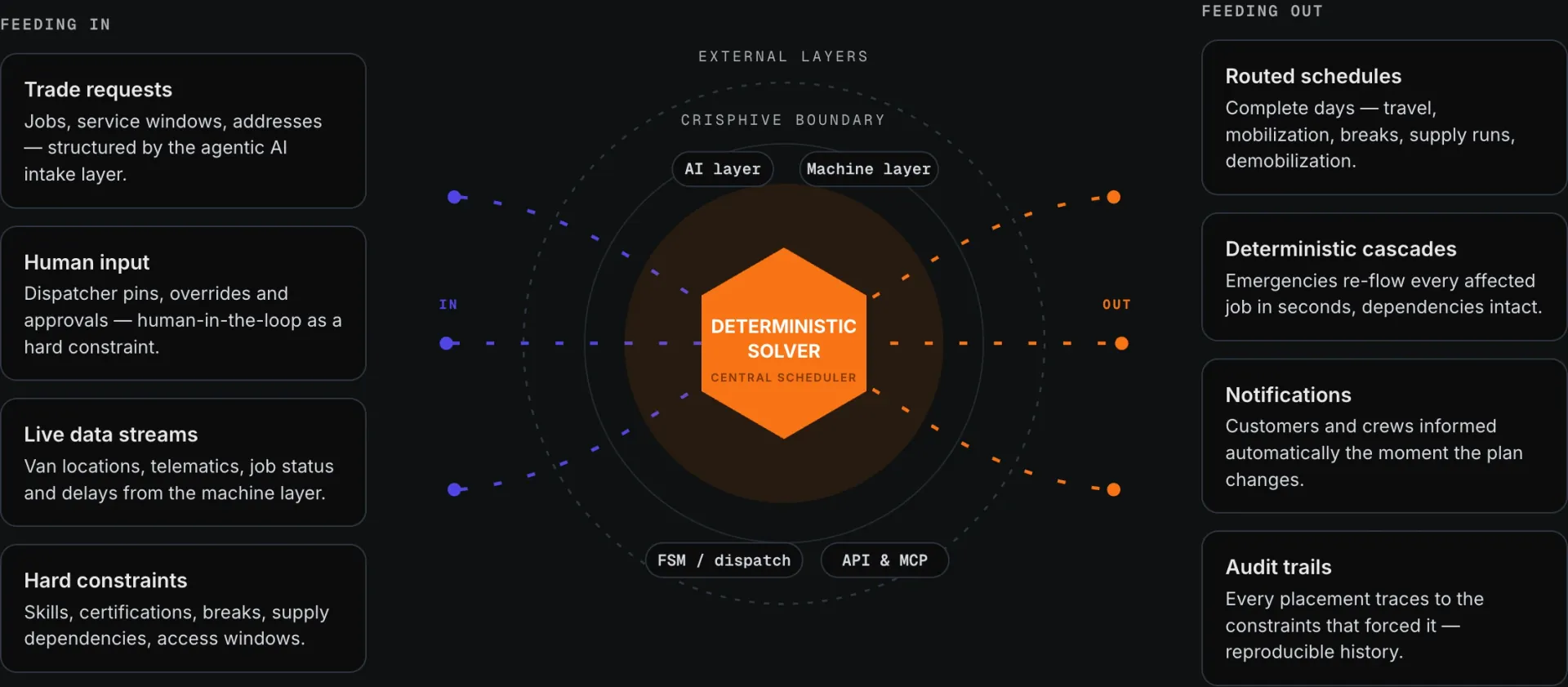
The core is a deterministic solver: the same inputs always produce the same plan, which makes every schedule explainable and audit-ready. LLMs sit only at the intake and explanation edges — they never place jobs on the board.
Which constraints does Crisphive treat as hard rules?
Skills and certifications, travel time between stops, mobilization and demobilization, protected crew breaks, supply pickups that must happen before the jobs that need them, and access or compliance windows. They are hard constraints, not suggestions — a plan that violates one is never offered.
Does Crisphive replace my existing dispatch or FSM software?
No. Crisphive is scheduling infrastructure, not a walled garden — it runs alongside or inside the dispatch, FSM or booking software your business already uses, through a REST API and an MCP server. You keep your system of record; Crisphive does the scheduling math.
How can I try the scheduling engine before committing?
Use the free sandbox — no signup required. A test-mode API key gives you an isolated test environment against the same base URL, so you can model a real day of jobs and watch a cascade before putting anything into production.

The scheduling tool your agents call.

Crisphive is infrastructure, not a walled garden — booking, routing and re-planning that works alongside whatever your business already runs on.