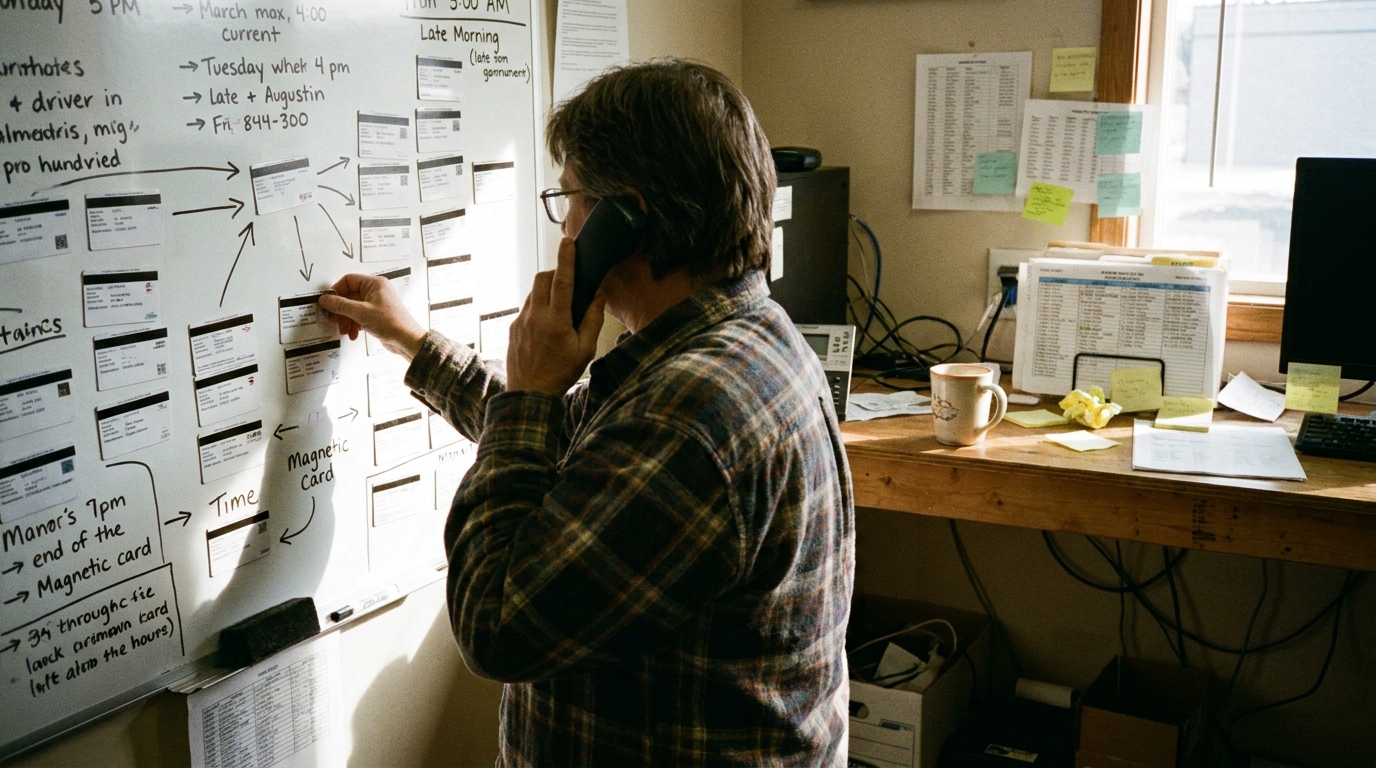

What Is Windshield Time? Definition, Formula, and Why It Matters
Windshield time is the paid drive time between field-service stops. Here is the plain-English definition, formula, worked example, and how to use it without turning it into a technician scorecard.
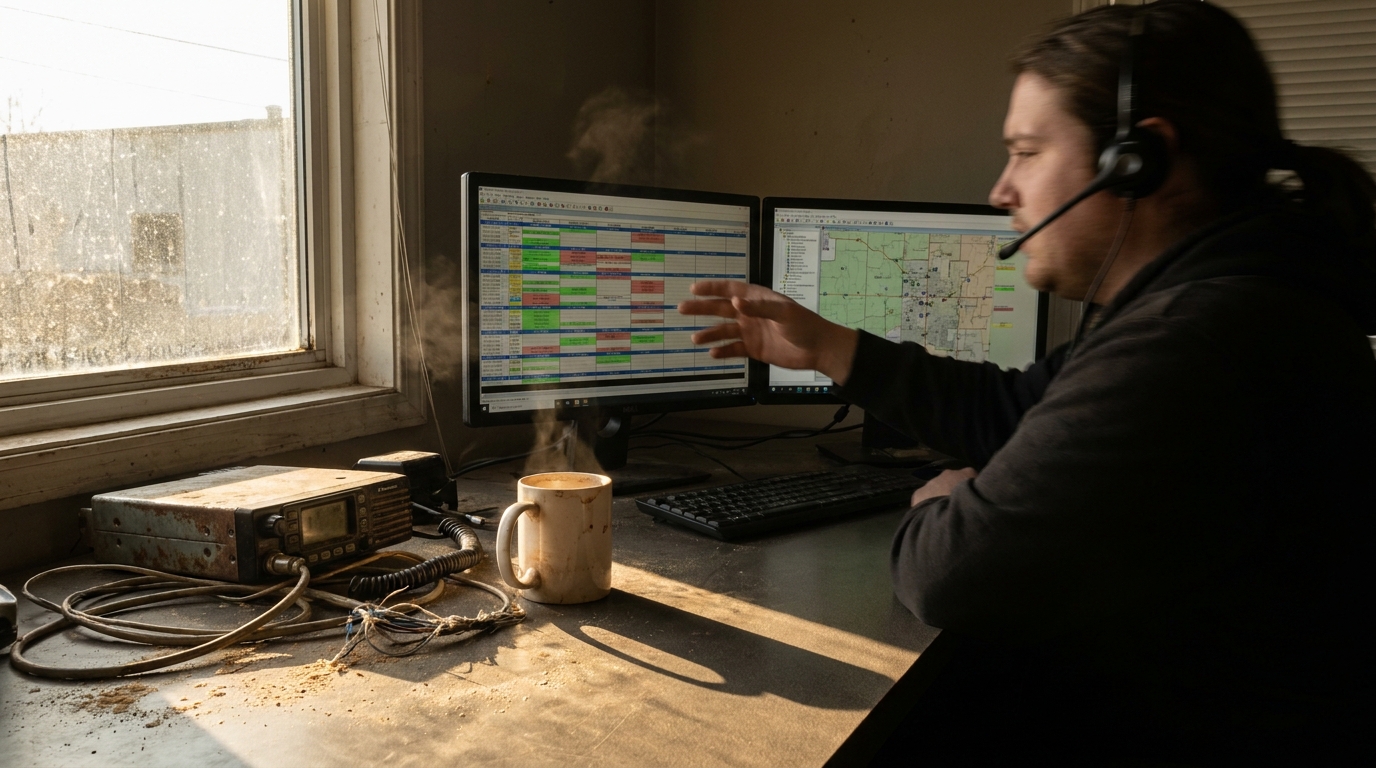
Windshield time is the paid time a field technician spends driving between jobs, the shop, a supplier, or home base instead of doing billable work on-site. It is not automatically waste. Crews have to travel, and a good route still contains road time. The term matters because it gives operators a plain way to discuss the gap between a full calendar and a productive day. For searchers, evaluators, and office teams comparing dispatch terminology, windshield time is one of the simplest field service glossary terms to understand and one of the easiest to misuse.
Windshield Time: plain-English definition
In plain English, windshield time is time seen through the windshield: the minutes or hours a technician spends moving from one place to another during the workday. In dispatch terminology, it usually sits next to travel time, route density, technician utilization, and job duration. A business may track it per technician, per job, per route, per service area, or per day.
The useful definition is operational, not moral. A long drive to a remote customer can be necessary. A second long drive caused by weak scheduling, missing parts, or a poor handoff is a different problem. That distinction keeps the metric practical. It asks whether the schedule is asking technicians to do too much unpaid movement, not whether technicians are working hard enough.
Windshield time also does not measure customer satisfaction, workmanship, first-time fix quality, or the fairness of a route. A lower number can be bad if it comes from overloading one neighborhood while ignoring promised arrival windows elsewhere. Treat it as a dispatch signal, not a surveillance scorecard.
Why it matters in field service
Windshield time matters because field service businesses sell the results of skilled work, but the day is shaped by movement. Every extra trip has a knock-on effect: a narrower arrival window, a late handoff, a rushed note, or a technician who reaches the last call with less patience than the job deserves. That is why how to improve windshield time is really a question about the whole operating rhythm.
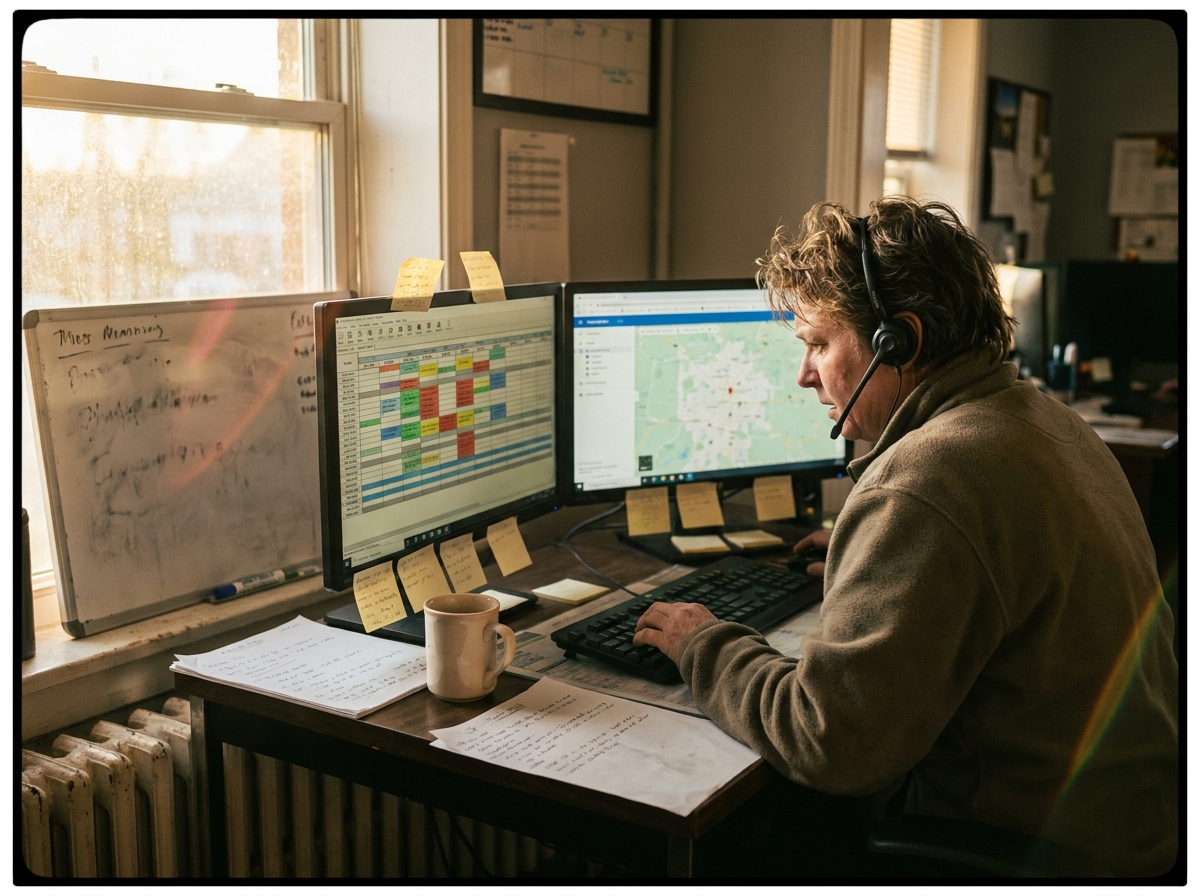
The problem is easy to hide. A calendar can look full while the route underneath it is scattered. A dispatcher can add another job because there is white space on the board, then discover that the real constraint is geography, not labor. Windshield time for small business operations shows up quickly, and small businesses feel this because one awkward route can affect the office, the customer, and the technician at the same time.
It also affects software evaluation. A buyer comparing a ServiceTitan alternative, a Jobber alternative, or another windshield time software option should ask how the system helps the office see travel before the route becomes painful. The point is not whether one platform owns the phrase ServiceTitan windshield or any other search term. The point is whether dispatch can make better choices before the truck is already moving.
How it's calculated or applied
The basic formula is simple: windshield time equals the time spent traveling between field-service stops during the working period being measured. If a technician leaves Job A at 10:10, arrives at Job B at 10:45, and that movement is part of the work route, the route has 35 minutes of windshield time for that leg. Add the legs together to understand the day.
Teams apply the number in a few practical ways. They compare planned travel with actual travel. They look for routes where jobs are grouped poorly. They review whether emergency work is breaking the board too often. They may also compare similar service areas to see whether one territory is carrying more movement than the others.
For broader operating context, teams sometimes keep labor-market reference pages such as the BLS Occupational Outlook Handbook, market research portals such as Statista, or industry research libraries such as IBISWorld near their planning work. Those links do not calculate windshield time for a company. They simply sit beside the internal schedule, job notes, payroll rules, and route history that actually define the metric.
A useful application also separates avoidable and unavoidable travel. Driving across town for a planned high-value job may be fine. Driving across town because the nearest qualified technician was not visible on the board may point to a dispatch problem. The calculation starts with minutes, but the decision comes from context.
A worked example
Imagine a technician with four calls on the board. The first drive from the shop to Job 1 takes 25 minutes. Job 1 to Job 2 takes 18 minutes. Job 2 to Job 3 takes 42 minutes because the schedule jumps to the other side of town. Job 3 to Job 4 takes 16 minutes, and the return to the shop takes 20 minutes. The day contains 121 minutes of windshield time.

That number alone does not say the day was bad. Maybe Job 3 required a specific skill, and the customer could not wait. But it gives the dispatcher a concrete question: could Job 3 have been paired with a nearby call, moved to another technician, or scheduled in a different window without hurting service?
Now compare the same four jobs grouped differently. If a tighter route cuts the middle jump, the technician may not gain a new job slot immediately. The office might instead gain a more realistic arrival window, a less rushed closeout, or enough buffer to absorb a parts stop. Those are still business outcomes. The best windshield time is not always the lowest possible number. It is the amount of travel that supports the promise made to the customer and the work expected from the crew.
How Crisphive treats it
Crisphive treats windshield time as one signal inside a scheduling and dispatch workflow, not as a standalone verdict on a technician. The important handoff is between the calendar, the route, the skill needed for the job, the customer window, and the field notes that tell the office what actually happened.
In practice, that means the office should be able to see when a route looks clean on paper but brittle in the field. A dispatcher needs enough context to notice when the next open slot is not the best slot, when a job belongs with a different technician, or when the customer promise should be adjusted before it becomes a late arrival.
For teams reading windshield time 2026 buying guides, the durable question is not whether a product claims to optimize routes. It is whether the tool helps the business make calmer decisions under pressure. Windshield time examples are most useful when they lead to better dispatch judgment: tighter territory planning, clearer buffers, cleaner job sequencing, and fewer avoidable surprises.
Related terms
Travel time is the broader phrase for time spent moving from one place to another. Windshield time is the field-service version operators use when the technician is on the road during the workday.
Route density describes how closely jobs are grouped. Better route density often reduces windshield time, but it can conflict with skill requirements, customer urgency, and promised arrival windows.
Technician utilization compares how much of a technician's paid day goes to productive field work versus travel, admin, waiting, and other non-job activity. Windshield time cost belongs in that conversation, but it should not swallow the whole view of the day.
Dispatch efficiency is the office-side habit of assigning the right technician, route, and window with enough context to avoid preventable rework. That is where windshield time tips usually become useful: reduce avoidable movement, preserve service quality, and keep the board honest.
Field service glossary entries can sound simple, but the practical value comes from using the term consistently. When everyone means the same thing by windshield time, the office can talk about the route without blaming the technician or hiding behind a messy calendar.
#Glossary#Definition#FieldService#Data#IndustryInsights#Trends#Leadership#FieldOps#SmallBusiness#dispatch#scheduling#AI#automation#SaaS#B2B#Productivity